Case study
Filter-array bonding, calibration, and ISP integration
IMX990 SWIR Polarization Camera
PolarX aligns and bonds pixelated filter arrays to bare image sensors, then builds the calibration and ISP for usable output. This is a Sony IMX990-based SWIR polarization camera built through that workflow.
Case-study platform
Sony IMX990-AABJ
SVS-VISTEK exo990MGE
PolarX scope
Precision alignment and bonding, internal process software, calibration, customer software / ISP, and deployment support
Workflow
Platform-specific pixelated array integration workflow
Every platform needs its own mechanical, optical, and software path. This is how PolarX adapts pixelated filter arrays to a given sensor — including platforms that need cover-glass removal before bonding.
Platform review and intake
Review the sensor stack, package, optical path, and camera constraints to plan integration and flag risks.
Cover-glass removal
Where needed, develop removal tooling and SOPs with a UV/CO₂ laser, then clean and prepare.
Platform-specific tooling
Custom fixtures for handling, registration, bonding, and rework on the target hardware.
Filter-array integration
Define the bonding process — adhesive stack, placement, and controls for repeatable integration.
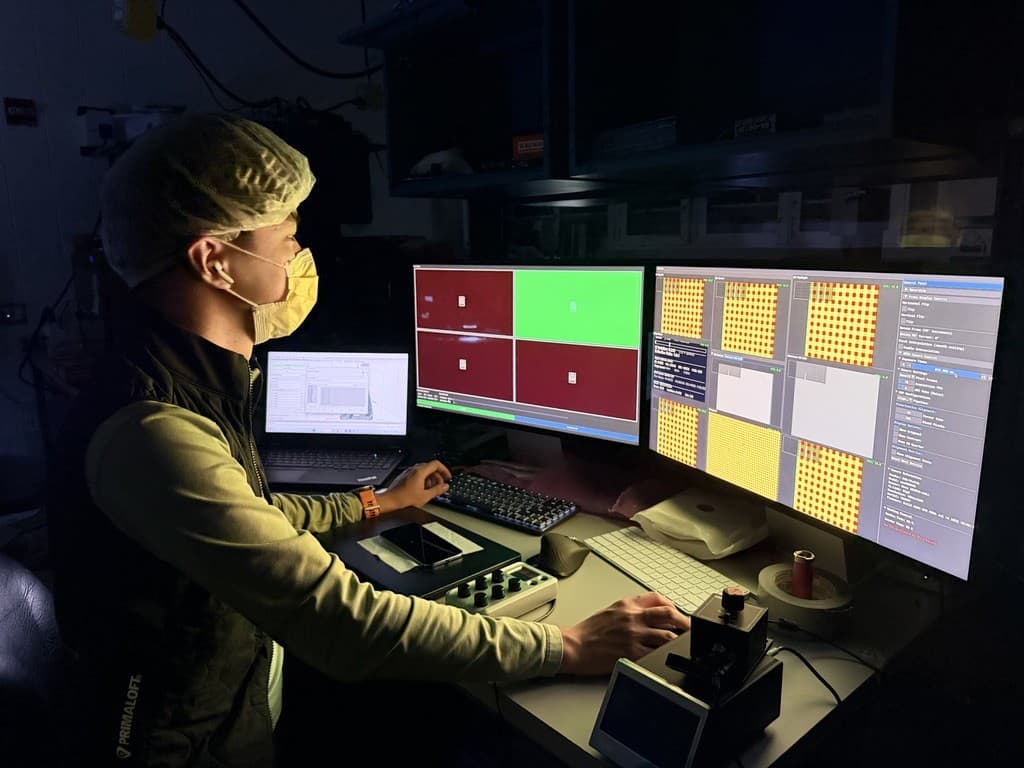
Cleanroom alignment and bonding
Align in a cleanroom with realtime feedback and ROI metrics, pushing registration to the sensor's limit.
Performance verification
Verify optical and mechanical registration, inspect the assembly, and benchmark the baseline.
Calibration and ISP
Develop and tune calibration files and ISP for stable output and better effective contrast.
Software integration
Build customer software, visualization, controls, and export for the target platform.
Software stack
Process and application software
Two layers: internal process software for alignment and bonding, and customer-facing camera software and ISP that PolarX can customize.
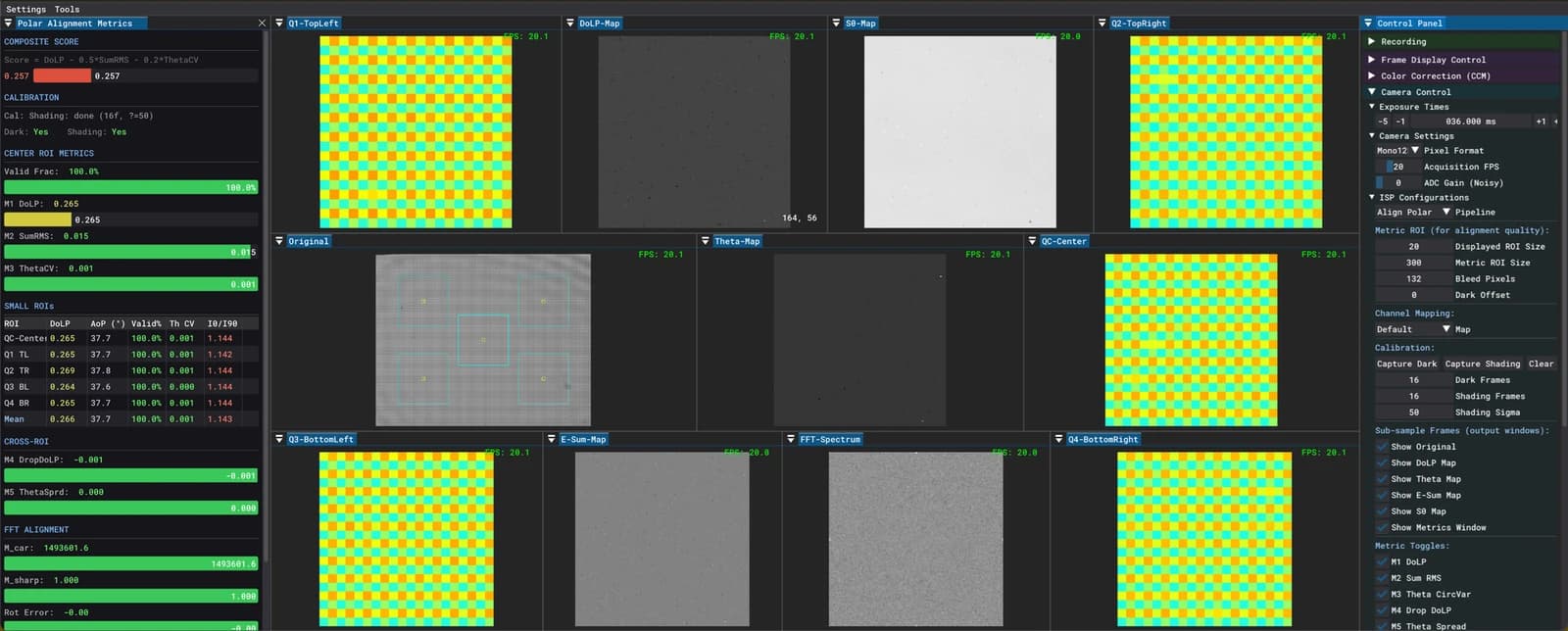
Realtime alignment feedback
Realtime sensor feedback, ROI metrics, and spatial checks drive alignment to the best attainable registration.
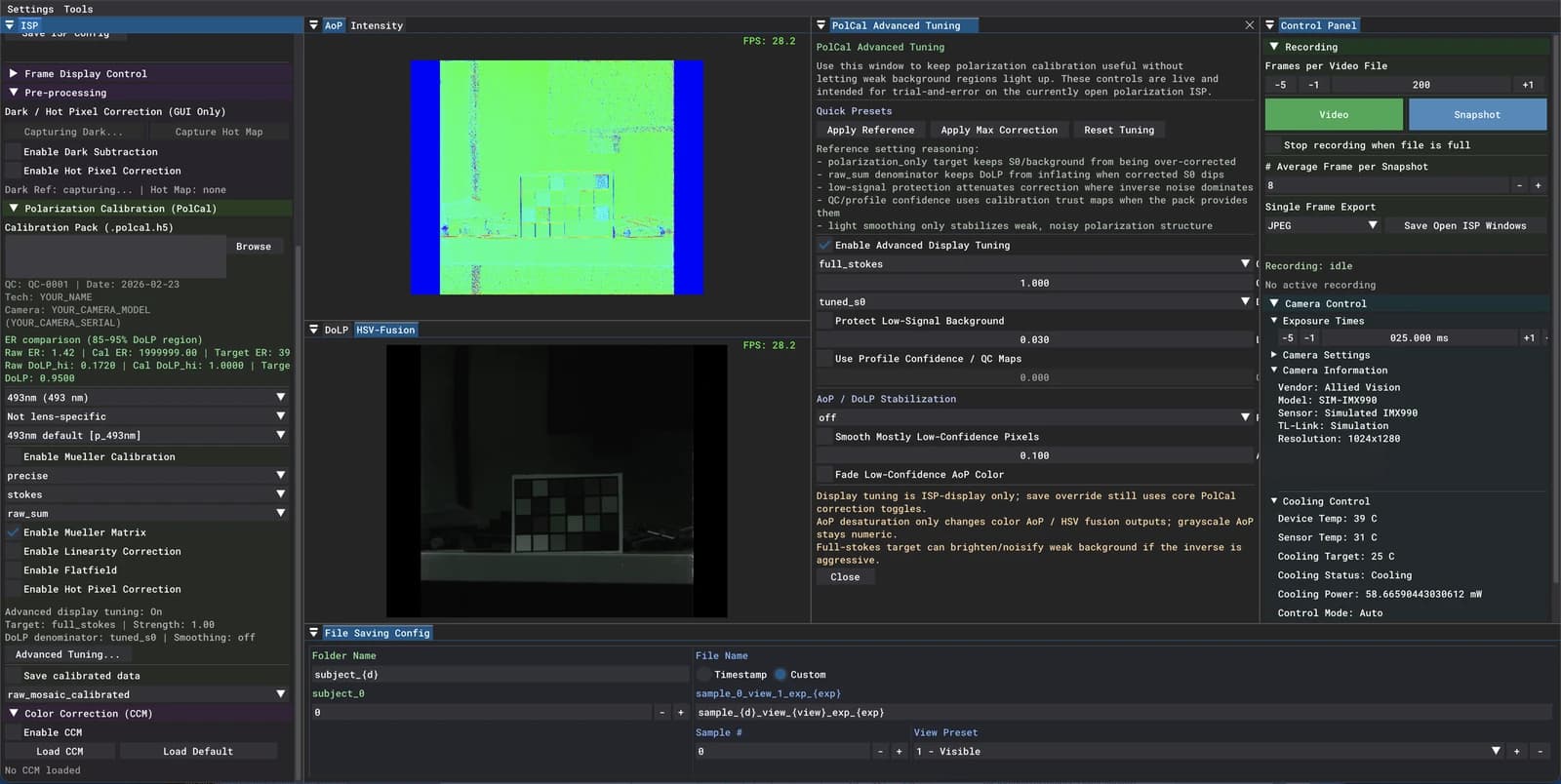
Calibration-aware camera software
Calibration loading, visualization, tuning, and export — customizable for the customer workflow.
Live demo
Sensor output in action
The platform delivers synchronized polarization views — AoP, DoLP, intensity, and HSV fusion.
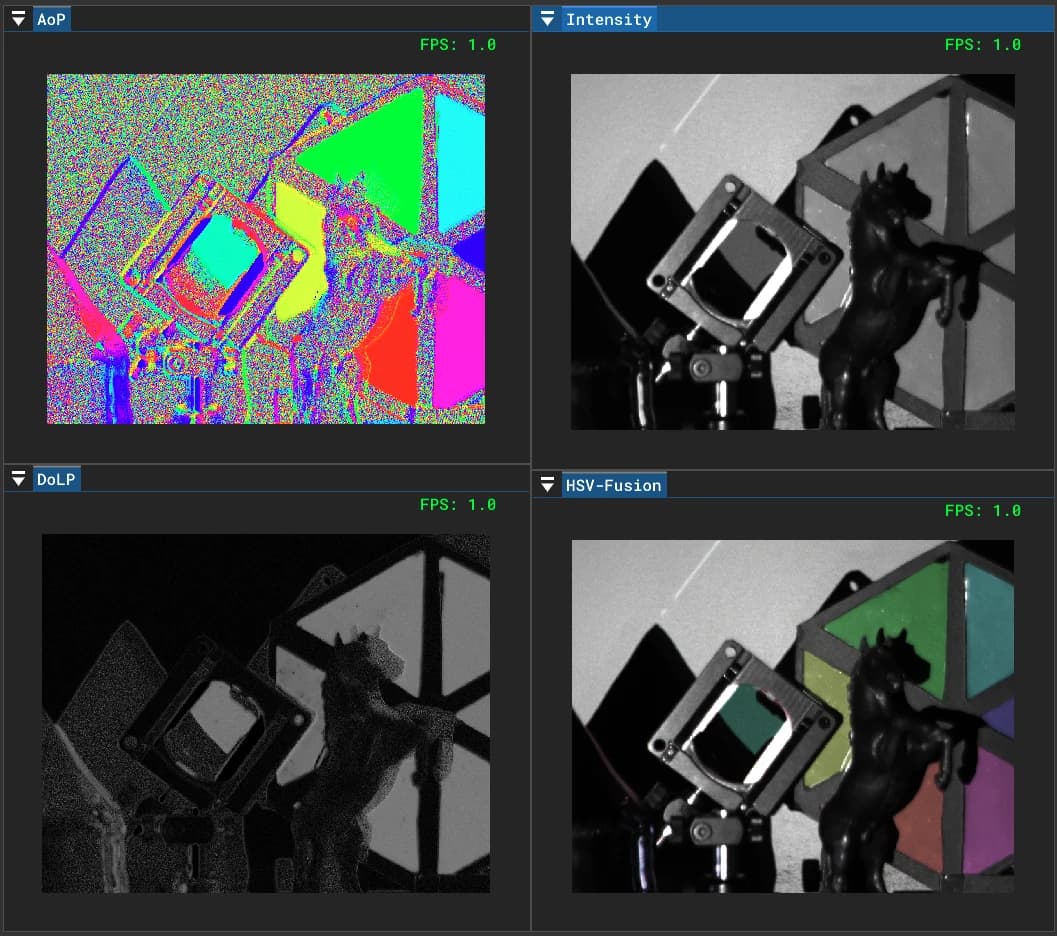
Live IMX990 output with multiple polarization-derived views in parallel.
Performance review
Raw and calibrated, read together
Raw shows the bonded hardware baseline after alignment. Calibrated shows the added gain from calibration files and ISP.
- Raw extinction ratio — bonded-stack baseline before calibration
- Calibrated effective ER — raised by calibration files and ISP
- Malus response @ 600 nm — four-channel separation, raw and calibrated
Measurement plots are shared under NDA during technical review.
Platform extension
Applicable beyond polarization cameras
The IMX990 is one example. The same bonding, calibration, and software approach adapts to other sensors, pixelated filter arrays, and imaging pipelines.
- RGBN pixelated filter arrays — visible-band mosaics beyond polarization
- Visible + NIR broadband filter-array systems